
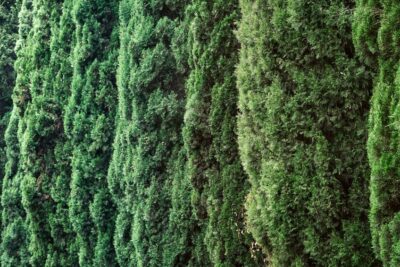
When you’re planting trees for privacy, it’s tempting to put them close together so you can block the view as quickly as possible. But a privacy screen isn’t just about how it looks next year—the goal is to create a screen that fills in well while giving each tree enough room to grow and stay healthy for years to come.
Finding that balance starts with understanding that there’s no one-size-fits-all number. The right spacing depends on what you’re planting, how large it will become, and how you arrange it.
How Much Space Do Privacy Trees Need?
There isn’t one spacing distance that works for every privacy screen. A good starting point is the mature width of the trees or shrubs you’re planting, but the ideal distance also depends on the species, growing conditions, and how dense you want the finished screen to be.
For example, a tree expected to grow 12 feet wide will naturally require more room than a narrow-growing evergreen. Spacing is generally measured from the center of one plant to the center of the next, rather than from the outer branches.
Before planting, it’s important to consider:
- The plant’s expected mature height and width
- How quickly the species grows
- Whether it tolerates close planting
- Available sunlight, soil, and moisture
- How much room you have along the property line
- How quickly you want the screen to fill in
In other words, don’t base your spacing on how the plants look when they arrive. Plan for the size they’re expected to reach.
How Can You Create a Fuller Privacy Screen Without Overcrowding Trees?
It can be tempting to reduce spacing when you want privacy sooner, but planting trees too close together can create problems as they mature. Overcrowded trees may compete for sunlight, water, nutrients, and growing space, while limited airflow can contribute to conditions that favor certain diseases.
Instead, consider the layout of your screen. A single row can work well when space is limited, while a staggered double row can help create fuller coverage on larger properties or for windbreaks. In a staggered layout, trees in the second row are positioned between the trees in the first, helping close visual gaps without squeezing more plants into the same row.
If faster coverage is important, you might also combine appropriately spaced trees with shrubs suitable for privacy plantings. The goal is to create density through thoughtful plant selection and layout rather than simply putting trees closer together.
When Should You Plant a Privacy Screen?
Timing matters, especially when you’re working with bare root trees and shrubs. Bare root plants are generally planted while dormant, with spring and fall offering common planting windows depending on the species, climate, and local conditions. The ground should be workable, and newly planted trees need adequate moisture as their roots become established.
Planning ahead can be particularly useful for a long property border or another project requiring dozens—or even hundreds—of plants. It gives you time to calculate your spacing, determine how many plants you’ll need, and place an order for the appropriate planting season.
Plan a Privacy Screen That Can Grow With Your Property
A successful privacy screen doesn’t have to appear overnight. Giving your plants enough space now can help create the dense, established barrier you’re looking for later.
When you’re ready to choose trees and shrubs for a privacy screen, Cold Stream Farm offers evergreen and deciduous trees and shrubs for backyard screens, property borders, windbreaks, and other landscaping applications, with quantity ordering options for larger projects. Browse our available plants and start planning for the upcoming planting season.